
Updated September 2026
To hire a full-stack engineer at a startup, first decide which side of the stack your next six months of hard problems sit on, then hire someone who is deep on that side and comfortable on the other. Write a scorecard around those projects, run a short interview loop with one realistic build exercise, and move from first call to offer within two to three weeks.
"Full-stack" is one of the most common job titles at early-stage companies and one of the least precise. Nearly every engineer who calls themselves full-stack has a centre of gravity, and it tends to show up in the first month on the job. If you hire a frontend-leaning engineer to build a billing system, or a backend-leaning one to own your onboarding flow, you get someone capable working slightly outside their strength on exactly the work that matters most.
Every full-stack engineer leans one way
A good full-stack engineer can ship a feature from the database to the button. What varies is where they are fastest and where their judgement is sharpest. Some have spent years on interfaces, state management and accessibility. Others have spent them on data models, APIs and the parts of the system that break at 3am.
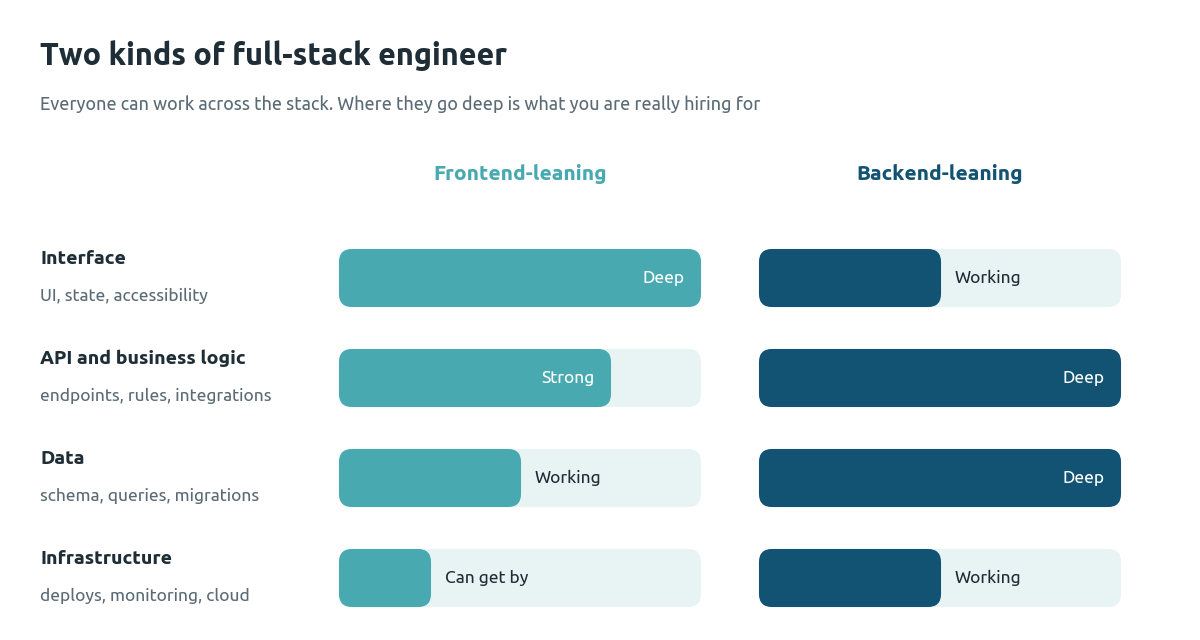
Neither profile is better. The mistake is writing a job description that asks for both at an expert level, which filters out most strong candidates and attracts people who describe themselves generously. Pick the lean, say it in the job description, and you will get a clearer pool.
A simple way to find the lean: map your next three projects
Take the three things this hire will ship first. For each one, ask where the hard part lives. Most features touch every layer, so look for where the difficult decisions and the likely bugs will be.
Here is an illustrative example from a B2B product. Usage-based billing is hard in the API and data layers: metering, idempotency and reconciliation. A self-serve onboarding flow is hard in the interface. A customer reporting dashboard looks like frontend work, but the hard part is usually the queries and the data model underneath.
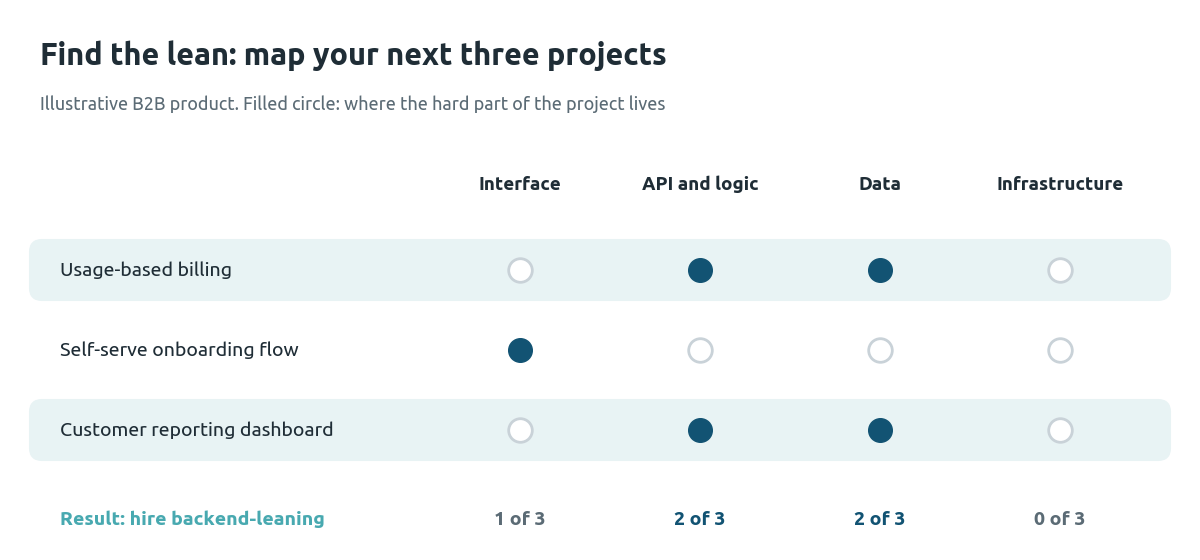
Two of the three projects are hard on the backend, so this team should hire backend-leaning and accept a working level on the interface. If the map comes out even, look at what your current team is weakest at and lean that way.
What to put in the scorecard
A scorecard for a full-stack hire should name outcomes, not technologies. "Ships usage-based billing to our first ten paying accounts within 90 days" tells a candidate far more than a list of frameworks. Add three or four competencies you will test, such as data modelling, product judgement, debugging under pressure and clear written communication.
Be specific about the stack you run, but relaxed about exact matches. An engineer who knows one mainstream web framework well can usually pick up another within weeks. Depth of thinking about data, state and failure modes transfers across languages much better than syntax does.
An interview plan that tests the right things
Keep the loop short. Strong full-stack candidates are often talking to several startups at once, and a five-week process loses them to whoever moves first.
| Stage | What it tests | Who runs it | Length |
|---|---|---|---|
| Intro call | Motivation, the lean, what they want to build next | Founder or CTO | 30 minutes |
| Past project deep dive | Decisions they made, trade-offs, what they would change | Senior engineer | 60 minutes |
| Build exercise | A small feature across two layers, weighted to the lean | Two engineers | 90 minutes, paired |
| Product conversation | How they scope, push back and talk to users | Founder or product lead | 45 minutes |
| References | How they work when things go wrong | Hiring manager | Two calls |
For the build exercise, pair with the candidate rather than setting take-home work. You see how they think, they see how your team works, and nobody loses a weekend. Weight the exercise to the lean you chose: for a backend-leaning hire, give them a data model to design and a thin interface to wire up.
What it costs to use a recruiter for this hire
Take an illustrative base salary of $135,000 (swap in your own number). A contingency recruiter charging 20 to 25% of salary would bill $27,000 to $33,750 for the hire. On Funded.club's fixed-fee bands, the same role falls in the up to $150,000 band at $11,500, agreed before the search starts. The full breakdown is on our pricing page.
Where Funded.club fits
We are a fixed-fee recruiting partner for funded startups and fast-growing teams across North America, Europe and APAC, and engineering is one of the areas we hire for most. We've helped 500+ startups from Seed to Series D, including Supernova.io, WeTravel and Cobalt Robotics.
One dedicated recruiter runs your search end to end, from sourcing and headhunting to screening and support through the offer. We help you pin down the lean before we start sourcing, and you see your first screened candidates within 7 days. Our average from kick-off to hire is 33 days. Our fees average 6 to 9% of salary, from $4,900 to $21,900 per hire, with part paid as an advance and the balance when your candidate accepts. If we don't deliver a shortlist of at least 3 qualified candidates within 30 days, you can claim the advance back in full. If this is one of your early engineering hires, our guide to the first 10 hires after funding may help with sequencing.
Frequently asked questions
Should a startup hire a full-stack engineer or specialists?
Most startups with fewer than ten engineers get more from full-stack engineers, because work shifts between layers from week to week. Specialists start to make sense when one part of the system, such as data infrastructure or a complex interface, needs someone full time.
How do I tell if a full-stack candidate leans frontend or backend?
Ask them to walk through the hardest bug they fixed in the last year and the part of a past project they are proudest of. Both answers almost always sit on the side of the stack where they are strongest.
How long does it take to hire a full-stack engineer?
With a clear scorecard and a short interview loop, three to six weeks is realistic. Funded.club delivers first screened candidates within 7 days and averages 33 days from kick-off to hire.
What does a recruiter cost for a full-stack engineer?
Contingency recruiters usually charge 20 to 25% of first-year salary. Funded.club charges a fixed fee by salary band, for example $11,500 for a role paying up to $150,000.
Worth a brief chat about your next hire? Book a free call.
Hiring after a funding round?
First candidates in 7 days. Fixed-fee, no commission.