
Updated September 2026
To hire a head of product at a startup, start by writing down which product decisions you, the founder, will hand over and by when. If you are not ready to give up the roadmap within a few months, you need a senior product manager, not a head of product. Once the handover is clear, test candidates on real decisions from your own backlog rather than on frameworks.
Most head of product hires that fail come down to an unclear handover. The founder keeps making the product calls, the new hire becomes an expensive project manager, and both sides are frustrated within six months. The fix is to decide the handover before you open the role, and to use it to shape the title, the scorecard and the interviews.
Senior PM, head of product or CPO
These three titles get used loosely, so it helps to define them by what the person decides rather than how senior the title sounds.
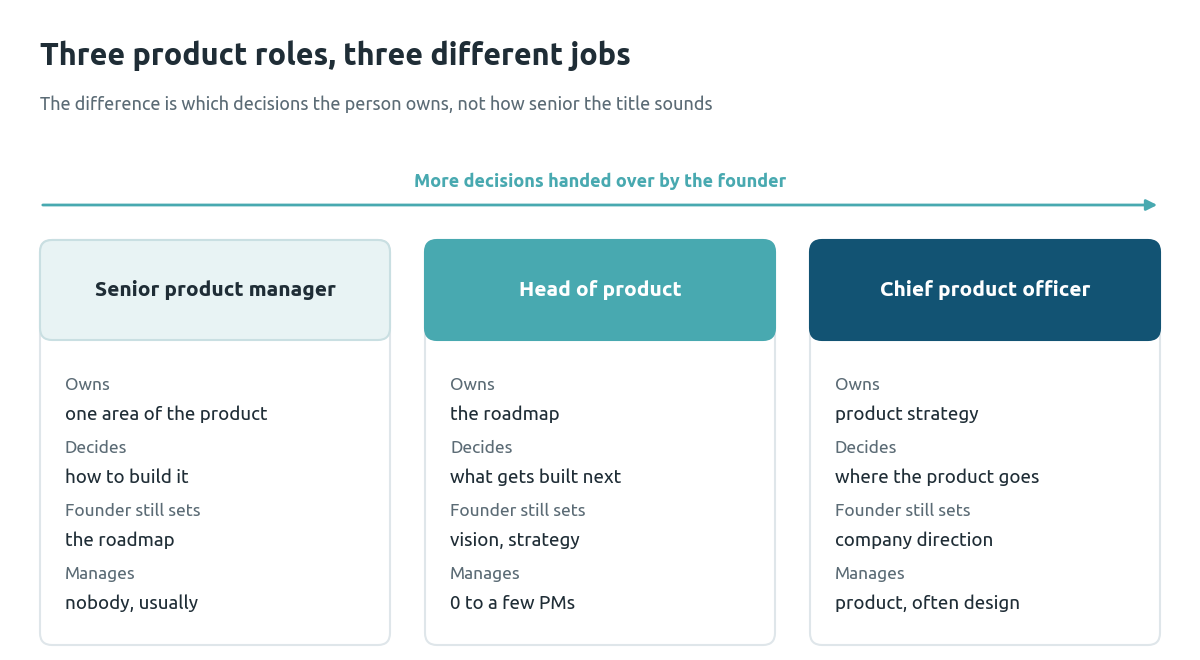
A senior product manager owns one area and decides how it gets built, while the founder still sets the roadmap. A head of product owns the roadmap and decides what gets built next, often while managing a small team of PMs. A chief product officer owns product strategy and usually sits on the leadership team alongside design. If you are still the person customers and investors expect to talk to about the product, a head of product is usually the ceiling for now.
Run the handover test before you open the role
List the product decisions you made in the last month, such as sprint priorities, what research to run, what goes on the roadmap next quarter and when to hire more PMs. Then mark which of those you would hand to this person, and when.
Here is an illustrative example. A founder-CEO has been acting as product lead for a team of about ten engineers. They are ready to hand over sprint priorities and discovery straight away, the quarterly roadmap after one planning cycle together, and PM hiring once the new hire has proven their judgement.
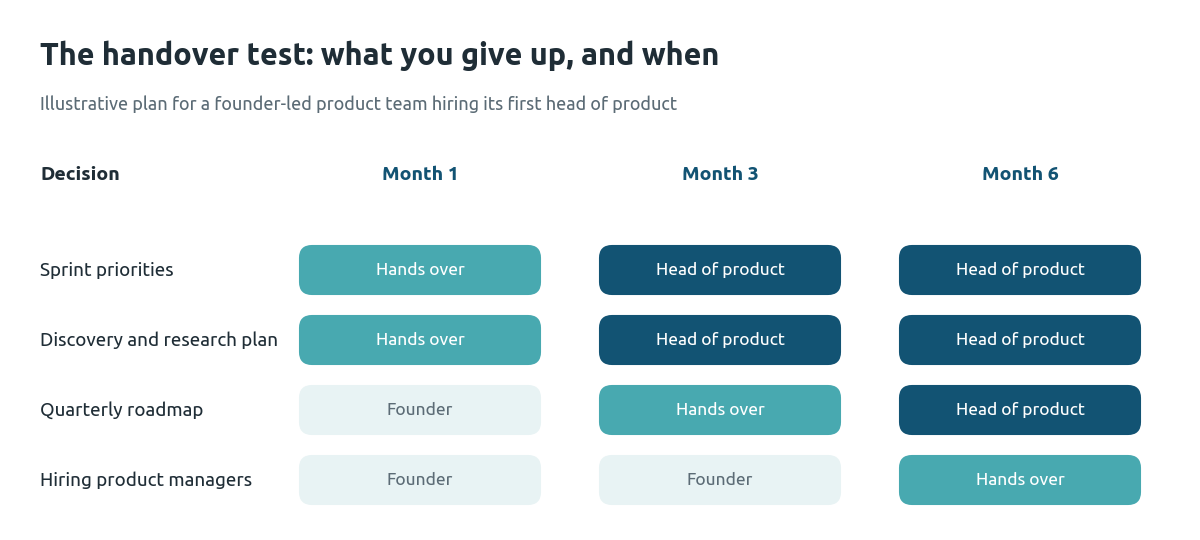
That plan is a head of product role. If the founder could only hand over sprint priorities, it would be a senior PM role, and the job description should say so. Share the plan with finalists, because the best candidates will ask about it anyway, and it shows you have thought about how they will succeed.
What to look for in candidates
- Judgement on trade-offs. They can explain what they chose not to build and why, with examples from their last role.
- Comfort with thin data. At a startup, most decisions are made with a handful of customer conversations. Look for people who move with that rather than waiting for certainty.
- A working relationship with engineering. Ask engineers who worked with them how priorities were set and how disagreements ended.
- Ability to disagree with you. A head of product who always agrees with the founder is not taking anything off your plate.
An interview plan for a head of product
| Stage | What it tests | Who runs it |
|---|---|---|
| Founder conversation | Motivation, the handover plan, how they like to work with a founder | CEO |
| Product decision review | How they reason through a real decision from your backlog | CEO and a senior engineer |
| Customer session | How they run discovery, listening to a customer or a recorded call | Customer-facing lead |
| Roadmap exercise | Turning your goals into a short, ordered plan with clear trade-offs | Leadership team |
| References | How they handled disagreement with founders and engineers | CEO |
Keep the roadmap exercise short and use your own context. A long take-home strategy document mostly tests how much free time a candidate has, and strong candidates often decline it.
What a recruiter costs for a head of product
At an illustrative base salary of $165,000 (swap in your own), a contingency recruiter charging 20 to 25% would bill $33,000 to $41,250. On Funded.club's fixed-fee bands, a role above $150,000 costs $15,900 to $21,900, agreed before the search starts. See pricing for the full bands.
Where Funded.club fits
We are a fixed-fee recruiting partner for funded startups and fast-growing teams across North America, Europe and APAC, and we hire product and leadership roles as well as engineering, sales and operations. We've helped 500+ startups from Seed to Series D.
One dedicated recruiter runs your search end to end: sourcing, headhunting, screening and support through the offer. We work through the handover plan with you at kick-off, so candidates hear a consistent story, and you see first screened candidates within 7 days. Our average is 33 days from kick-off to hire. Fees average 6 to 9% of salary, with part paid as an advance and the balance when your candidate accepts. If we don't deliver a shortlist of at least 3 qualified candidates within 30 days, you can claim the advance back in full. If you are also planning a technical leadership hire, our guide on how to hire a CTO for a startup covers similar ground.
Frequently asked questions
When should a startup hire a head of product?
When the founder is ready to hand over the roadmap, not just day-to-day prioritisation. That often coincides with the engineering team growing to the point where the founder can no longer set priorities for every squad personally.
What is the difference between a head of product and a CPO?
A head of product owns the roadmap and decides what gets built next. A CPO owns product strategy, usually sits on the leadership team and often manages design as well as product management.
Should my first product hire be a head of product?
Only if you will hand over the roadmap within a few months. If you plan to keep making most product calls yourself, a senior product manager is a better fit and easier to hire.
How much does it cost to hire a head of product through a recruiter?
Contingency recruiters usually charge 20 to 25% of first-year salary. Funded.club charges a fixed fee by salary band, from $15,900 to $21,900 for roles above $150,000.
Worth a brief chat about your next hire? Book a free call.
Hiring after a funding round?
First candidates in 7 days. Fixed-fee, no commission.