
Updated September 2026
A job scorecard for a startup role is a one-page document that sets out the role's mission, the outcomes the person must deliver at 90 days and at one year, and no more than three must-have competencies, each with the evidence you will look for and the interview stage that tests it. It replaces a list of requirements with a description of success. Use the three-month test to keep it short, treating anything a strong hire could learn in three months as a nice-to-have.
Most startups write a job description first and a scorecard never. The job description is for candidates. The scorecard is for you, your interviewers and your recruiter, and it is what stops five people interviewing for five slightly different jobs.
The four parts of a startup scorecard
- Mission. One or two sentences on why the role exists. If you cannot write it, you are not ready to hire.
- Outcomes. Three to five results, with dates, that would make you say the hire was a success. Write them as things delivered, not duties performed.
- Must-haves. Up to three competencies you would reject a strong candidate for lacking. For each one, note what good evidence looks like.
- Where it is tested. Map every must-have to the interview stage that checks it. A must-have that no stage tests is a wish, not a requirement.
That last column is the one most teams skip, and it is the one that makes the scorecard useful. It turns a list of hopes into an interview plan.
The three-month test
Founders tend to write long lists of must-haves because every extra line feels like protection. In practice each one shrinks the pool of people who qualify, and the ones that matter get lost among the ones that do not.
Two questions sort any requirement. Would you reject an otherwise strong candidate who lacked it? Could a strong hire learn it in their first three months?
Only items that pass the first and fail the second are true must-haves.
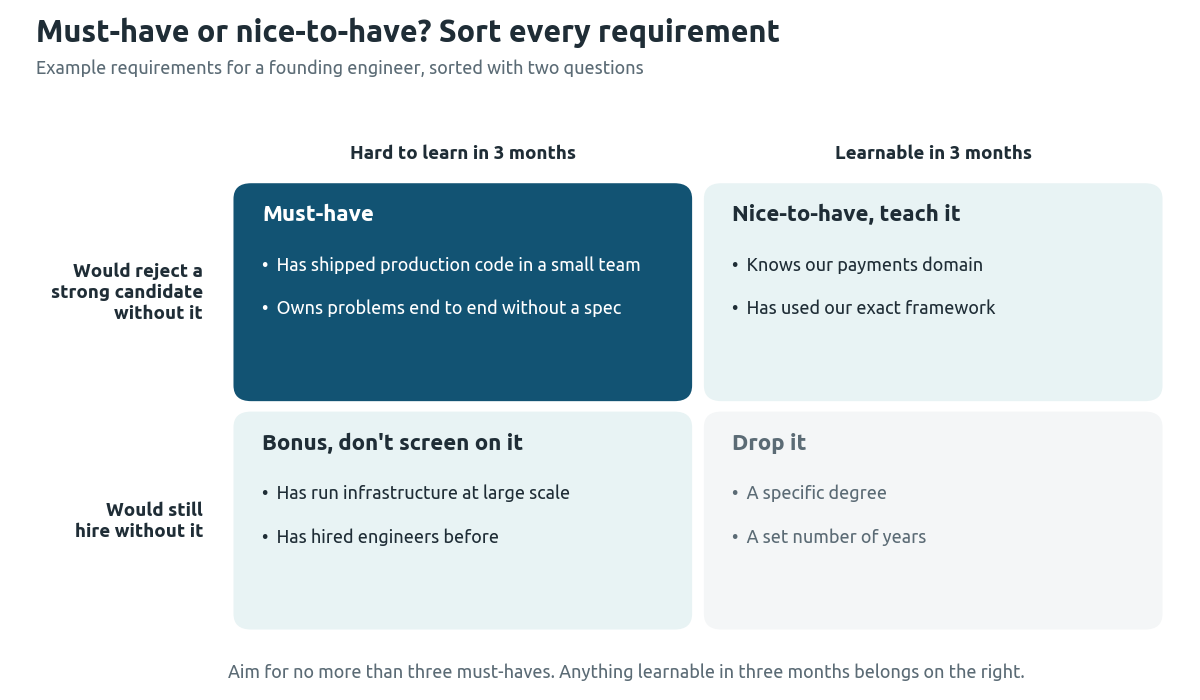
Your exact framework and your industry usually land in the learnable column. So does most tooling. What is hard to learn in three months tends to be judgement, ownership and the experience of shipping under real constraints.
Example: a scorecard for a founding engineer
Here is a completed scorecard for an illustrative Seed-stage startup hiring its first engineer after the founders. Adapt it to your own role rather than copying it word for word.
| Scorecard item | What good looks like | Tested in |
|---|---|---|
| Mission | Build and ship the core product with the founders, and set the engineering habits the next five engineers will inherit | All stages |
| Outcome, 90 days | First customer-facing feature shipped end to end, with deploys and basic monitoring in place | Founder interview |
| Outcome, 12 months | Product reliable enough for paying customers; helped hire and onboard the next two engineers | Final stage |
| Must-have 1 | Has shipped production code in a small team and can explain the trade-offs they made | Technical deep dive |
| Must-have 2 | Owns problems without a spec, with examples of deciding what to build after talking to users | Founder interview |
| Must-have 3 | Explains technical decisions clearly to non-engineers | Working session |
| Nice-to-have | Knows the payments domain; has used our framework | Noted, not scored |
Notice what is missing. There is no number of years, no degree and no list of eight languages. Each line describes something a candidate can show you, and each has a place in the process where someone is responsible for checking it.
Using the scorecard during the search
Share it with your recruiter at the kick-off and with every interviewer before their first conversation. Ask each interviewer to score only the rows assigned to their stage, with a short note of the evidence they heard. Debriefs get shorter because people argue about evidence rather than impressions.
Revisit it after the first three candidates. If everyone keeps rejecting people for a reason that is not on the scorecard, either add it or stop using it. Our guide on hiring a CTO for a startup shows how the same approach works for a technical leadership role.
Where Funded.club fits
Funded.club is a fixed-fee recruiting partner for funded startups and fast-growing teams across North America, Europe and APAC. We have helped 500+ startups from Seed to Series D hire across engineering, product, sales, marketing, operations, customer success and leadership, and every search starts from an agreed brief like this one.
One dedicated recruiter runs each search end to end, from sourcing and headhunting to screening against your scorecard and support through the offer. You see first screened candidates within 7 days, and searches take 33 days on average from kick-off to hire. The fee is fixed and agreed upfront, averaging 6 to 9% of salary, from $4,900 to $21,900 per hire (see pricing).
Part of the fee is an advance at the start and the balance is due when your candidate accepts the offer. If we don't deliver a shortlist of at least 3 qualified candidates within 30 days, you can claim the advance back in full.
Frequently asked questions
What is the difference between a job scorecard and a job description?
A job description is written for candidates and tries to attract them. A scorecard is written for the hiring team and defines success: the mission, the outcomes, the few must-haves and how each one is tested.
How many must-haves should a scorecard have?
No more than three. Every extra must-have shrinks the pool, so move anything a strong hire could learn in three months to the nice-to-have list.
Who should write the job scorecard?
The hiring manager, usually a founder at an early startup, with input from anyone who will interview. Agree it before the search starts and share it with your recruiter at kick-off.
Should a scorecard include years of experience?
Usually not. Years are a rough proxy for what you want. Describe the experience itself, such as having shipped production code in a small team, and test for it in an interview.
Worth a brief chat about your next hire? Book a free call.
Hiring after a funding round?
First candidates in 7 days. Fixed-fee, no commission.